
Shell Lubricant Solutions Europe: Our approach to sustainability
Lubricants play a vital role in keeping the world moving and machinery operating efficiently. The right lubricant solutions can improve efficiency, reduce maintenance requirements and extend equipment life. Delivering these benefits responsibly means providing products that can support operational performance while helping customers reduce fuel or energy use in their operations.
How are we reducing emissions¹ from our operations?

We are taking action across our operations and transforming the way we work.
Globally, as of 2025, over 50% of electricity used in Shell Lubricant blending plants comes from renewable sources2. In Europe, we source renewable electricity through contracts supported by renewable energy certificates, as well as from solar power generated on site.
In 2025, solar photovoltaic systems at our plants in Spain, Italy, Türkiye, Switzerland and Belgium generated around 1,800 MWh of renewable electricity. This is equivalent to the annual electricity consumption of approximately 500 average European households3, helping reduce emissions from our operations.
At our Hamburg plant, we undertook a multi-year transformation programme to reduce emissions while maintaining production output. As part of this site transformation, we consolidated operations in the northern part of the site and decommissioned units and tanks in the older southern section. These measures contributed to an approximately one-third reduction in the site’s absolute Scope 1 and Scope 2 greenhouse gas emissions compared with the 2016 baseline.4
How lubricants can improve energy efficiency
Developed by Shell’s technical experts, our high-quality lubricants are designed to help improve component efficiency, prolong equipment life and reduce downtime. By reducing friction and supporting effective thermal management, the right lubricant can help equipment operate more efficiently. Longer oil life can also enable extended drain intervals, helping reduce maintenance interventions and waste oil generation over the equipment lifecycle. Together, these benefits can contribute to more efficient use of energy and resources.
We offer products supported by appropriate evidence that are designed to help customers wishing to reduce energy use and associated emissions from specific equipment or activities.

How lubricant solutions can support circularity
The responsible recovery and re-refining of used oil can transform it into high-quality base oils, helping keep valuable resources in circulation, reduce waste and lower demand for virgin materials. Shell is supporting the use of circular and renewable ingredients, including re-refined base oils.
In Europe, Shell Risella C, our re-engineered process oils (REPO), can help customers develop formulations that contain more recycled material and have a lower carbon footprint5, without compromising on quality.
We continuously investigate packaging innovations and consider different formats and materials to reduce packaging waste and support a more circular use of resources. This includes increasing recycled content and reusing or reconditioning packaging where possible.
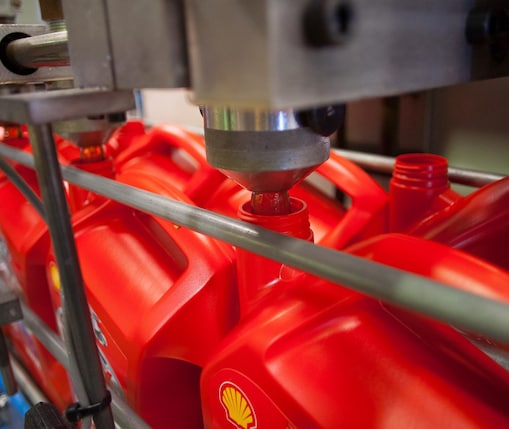
Since 2023, we have gradually replaced 20-litre round pails in Europe with jerrycans, which use 27% less plastic6 and are better suited to recycling.
Our European Lubricants portfolio includes 1L, 4L and 5L bottles containing up to 40% recycled plastic material. We also recondition and reuse intermediate bulk containers (IBCs) wherever possible, reducing both material consumption and associated manufacturing emissions.
Equipment Efficiency
High-performance lubricants can help reduce friction, improve equipment efficiency and support smoother operation, which may contribute to lower energy use.
Equipment Reliability
Advanced lubricants can help protect critical equipment, reduce wear and minimise downtime, supporting extended asset life.
Keeping resources in use
Lubricants made with re-refined base oils or renewable materials, together with recyclable and re-usable packaging and responsible used-oil management can help keep resources in use for longer.
Waste reduction
Using the right lubricant for the right application can help reduce waste by extending oil life, enhancing equipment protection and reducing maintenance requirements.
Disclaimers:
1 Scope 1 & 2 emissions; these are direct and indirect emissions from production of our lubricant products at Shell Lubricant Blending Plants.
2 Renewable sources include use of solar energy, renewable power contracts and renewable energy certificates (RECs)
3 Calculated using a typical European household electricity consumption of 3,500-4,000 kWh per year.
4 The reduction is based on comparison of absolute Scope 1 and Scope 2 greenhouse gas emissions against the 2016 baseline. The transformation programme was completed in 2020, and the reduction has been achieved and maintained since 2021.
5 Based on primary production data in 2023 Risella C is a product delivering approximately 22% lower carbon foot print compared to process oil manufactured by group II process intended for the same application and approximately 35% lower carbon foot print compared to process oil manufactured by group III process intended for the same application.
6 Over 27% plastic reduction when comparing 20L Jerrycans versus 20L round pails previously used.
Frequently asked questions
Can lubricants improve energy efficiency and help reduce emissions?
Can lubricants improve energy efficiency and help reduce emissions?
Yes. The right lubricants can help improve energy efficiency and contribute to lower energy consumption and associated emissions.
By reducing friction between moving parts, lubricants can help equipment operate more efficiently and use less energy. Advanced lubricant formulations may also support improved fuel economy, energy efficiency and thermal management, depending on the equipment, operating conditions and lubricant selection.
These benefits can help reduce energy use and the greenhouse gas emissions associated with that energy use. Lubricants can also contribute to waste reduction by helping protect equipment from wear, extending oil drain intervals and equipment life, and reducing maintenance requirements.7
What makes a lubricant more sustainable? Is there such a thing as a sustainable lubricant?
What makes a lubricant more sustainable? Is there such a thing as a sustainable lubricant?
Sustainability is not a single product attribute, and there is no universally agreed definition of a “sustainable lubricant”. Discussions on this topic continue across the industry and scientific community.
A lubricant may offer certain environmental benefits when it delivers the required technical performance while helping to reduce environmental impacts across its life cycle, in application or in the environment. Relevant factors may include improved energy efficiency, longer oil and equipment life, reduced lubricant consumption and waste, the use of circular or renewable raw materials, biodegradability, lower aquatic impact and smarter packaging.
For certain lubricant categories, the European Commission’s EU Ecolabel provides an independent benchmark.8 Its criteria include limited impact on the aquatic environment, restricted use of hazardous substances, protection of biodiversity, recycled content in packaging, and performance that is equivalent to or better than a conventional lubricant.
Environmental considerations need to be balanced with technical performance. The right lubricant should protect the equipment and perform effectively while helping to avoid unintended environmental trade-offs.
How do we assess lubricant biodegradability?
How do we assess lubricant biodegradability?
Biodegradability describes the extent to which microorganisms break down a substance under specified test conditions and within a defined period. Classifications are based on the percentage of biodegradation achieved using recognised test methods and criteria.
Assessment results depend on what is being tested, the methodology used and the test conditions applied. Shell uses internationally recognised biodegradability test methods and standards, including OECD test methods, such as OECD 301, and relevant industry standards, such as ISO 15380.
Shell supports accurate, transparent and evidence-based biodegradability claims. Biodegradability is an important product attribute, but it is only one aspect of product performance and should be considered alongside technical performance, durability, aquatic toxicity and intended application.
How is the carbon footprint of a lubricant calculated?
How is the carbon footprint of a lubricant calculated?
The carbon footprint of a lubricant is calculated by assessing greenhouse gas emissions across the lubricant’s life cycle. This includes raw material sourcing, manufacturing, packaging, transportation, loss in use and end-of-life treatment, depending on the scope of the assessment.
Relevant greenhouse gases, such as carbon dioxide (CO₂), methane (CH₄) and nitrous oxide (N₂O), are converted into carbon dioxide equivalents (CO₂e) and added together to provide the product’s carbon footprint.
Shell’s product-level carbon footprint calculations are based on internationally recognised life-cycle assessment methodologies and are assured against standards including ISO 14067 and PAS 2050.
Carbon footprint results may vary between studies, assessment dates or organisations, depending on the scope, underlying data sources, assumptions and calculation methodology. Carbon footprint values should therefore be interpreted and compared with care.
What happens to used lubricants, and can they be recycled?
What happens to used lubricants, and can they be recycled?
In Europe, used lubricants should be collected separately and handed over to an authorised waste-oil collection company or authorised recycling point, in accordance with applicable national and local requirements. They should never be discharged into drains, soil or water.
Not all used oil follows the same route. Depending on its type, quality, level of contamination, available infrastructure and local regulations, it may be reclaimed and reused, incinerated for energy recovery, or managed through other authorised waste-management routes.
Where technically suitable, used oil can be re-refined to recover base oils for use in the production of new lubricants. The re-refining process removes water, contaminants, oxidation products and other impurities. This allows a valuable base oil to be kept in circulation and can reduce demand for virgin base oils.
Disclaimers:
7 The extent of these benefits varies by application and operating conditions. Achieving improved energy efficiency depends on selecting the right lubricant for the equipment and using it in accordance with the manufacturer’s recommendations.
8 European Commission, EU Ecolabel: Lubricants and Commission Decision (EU) 2018/1702.
More from Shell Lubricant Solutions Europe: Our approach to sustainability

Our approach to sustainability
Find out more how Shell considers impacts, risks and opportunities related to climate, environment, safety, ethics, people and communities.
Lubricants and specialty fluids for business
Explore Shell lubricants, specialty fluids and services designed to support equipment performance and operational efficiency.

Explore our Lubricants Services
Access Shell tools and expertise, with support delivered on-site and virtually, as well as training programmes.