
Shell in the UK Diversity Pay Gap Report
At Shell in the UK, we want to create an environment that is as diverse as the communities in which we operate; where all employees are able to be themselves, thrive and deliver great work. Publishing our gender and ethnicity pay gaps (known as the diversity pay gap) is not only the right thing to do, but part of our Powering Lives strategy to become one of the most diverse and inclusive organisations in the world.

Parminder Kohli, Chair, Shell UK Ltd“We celebrate the richness of perspective, backgrounds, and cultures within Shell in the UK to ensure that everyone feels valued, respected and heard”

Diversity Pay Gap Report 2025
In our 2025 Diversity Pay Gap report, we set out the gender and ethnicity pay and bonus gaps for Shell companies in the UK and outline the actions we are taking to close these gaps.
View our 2025 diversity pay gap data and long-term progress.
View past years’ reports:
Reflecting on our long-term progress for the gender and ethnicity pay gaps
Gender Pay Gap
This year we reflect on our sustained long-term progress. Despite a small increase this year, we are proud that we have narrowed the gender pay gap of a range of 4.0% to 13.6% in 2025 compared to 11.3% to 32.1% in 2017.
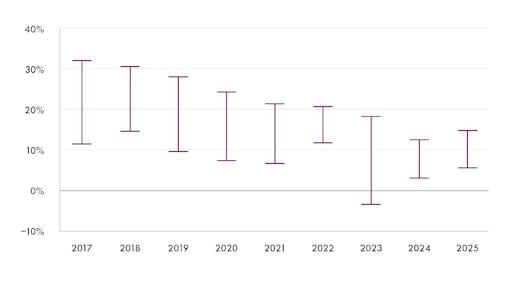
This data presents the range of the gender pay gap, showing both the lower and upper limits, for each year from 2017 to 2025. The pay gap is expressed as a percentage, where a positive percentage indicates men earning more than women, and a negative percentage indicates women earning more than men.
In 2023, the lower range of the pay gap was negative, indicating that in some cases, women earned more than men.
The upper range of the pay gap has decreased significantly over the years suggesting a narrowing of the pay disparity.
Transcript
Transcript
This chart shows the x-axis as the year and the y-axis as the pay gap.
In 2017 the upper range was 32.1% and the lower range was 11.3%.
In 2018 the upper range was 30.8% and the lower range was 14.4%.
In 2019 the upper range was 27.0% and the lower range was 9.1%.
In 2020 the upper range was 24.5% and the lower range was 7.8%.
In 2021 the upper range was 21.8% and the lower range was 7.3%.
In 2022 the upper range was 20.7% and the lower range was 11.7%.
In 2023 the upper range was 18.7% and the lower range was -3.7%.
In 2024 the upper range was 12.8% and the lower range was 2.7%.
In 2025 the upper range was 13.6% and the lower range was 4.0%.
Ethnicity Pay Gap
We are still in the earlier years of reporting our disaggregated ethnicity pay gaps. Through our action plan, we hope to see a similar long-term narrowing of the pay gaps.
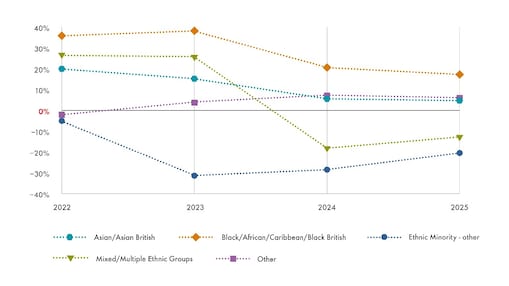
This data illustrates the mean pay gap percentage for various ethnic minority groups from 2022 to 2025, compared to the “white” ethnic group which is indicated at the 0% horizontal axis. A positive percentage indicates that individuals in the specified ethnic group earned less on average compared to the “White”, while a negative percentage indicates that the group on average earned more.
The Black/African/Caribbean/Black British group experienced the highest positive pay gap, though it has continued to decrease in 2025 The Asian/Asian British group has seen a steady decline in their pay gap over the four years. Conversely, the "Ethnic minority - other" and "Mixed/Multiple Ethnic Groups" both have negative pay gaps, indicating that they earned more on average than the “white” group. The "Other" group showed minor fluctuations.
Transcript
Transcript
This chart shows the x-axis as the year and the y-axis as the pay gap. There are 5 trend lines, each showing a different ethnic group, Asian/Asian British, Black/African/Caribbean/Black British, Ethnic Minority – Other, Mixed/Multiple Ethnic Groups, and Other.
Asian/Asian British
In 2022, the pay gap was 20.0%.
It decreased to 15.4% in 2023, then dropped further to 6.0% in 2024.
By 2025, it continued to decline slightly to 5.4%.
Black/African/Caribbean/Black British
In 2022, the pay gap stood at 36.2%.
It increased slightly to 38.9% in 2023, then fell sharply to 20.5% in 2024.
In 2025, it decreased again to 17.5%.
Ethnic Minority – Other
In 2022, the pay gap was -5.0% (indicating pay was higher for this group compared to the reference group).
It dropped further to -31.4% in 2023 and remained negative at -28.1% in 2024.
By 2025, it decreased slightly to -20.0%.
Mixed/Multiple Ethnic Groups
In 2022, the pay gap was 27.3%.
It decreased slightly to 26.3% in 2023, then fell sharply to -18.5% in 2024.
In 2025, it decreased to -13.8%.
Other
In 2022, the pay gap was -2.8%.
It moved to 3.5% in 2023 and increased to 6.9% in 2024.
By 2025, it decreased slightly to 5.3%.

Fair Pay in Shell
We commit to deliver fair and competitive pay, so that all of our employees are valued, respected and recognised for the work that they do.