Immersion Cooling Fluids
Find out how Shell’s gas-to-liquids (GTL) technology is enabling the latest immersion cooling solutions for data centres.
The benefits of liquid immersion cooling
Cloud computing, big data, blockchain, artificial intelligence, social media… data is all pervasive and is increasingly important in how we live our lives. To support this exponential data growth, data centre infrastructure is growing at >40% a year! Keeping these servers cool is cost intensive, uses enormous amounts of energy and generates a huge carbon footprint.
Full immersion in a thermally conductive, electrically non-conducting (dielectric) coolant is a highly efficient way to keep computer components cool. It can help to massively cut energy consumption and reduce carbon dioxide emissions while reducing costs and increasing location flexibility.
Compared with air or water cooling, single-phase, liquid immersion cooling offers a lower total cost of ownership through its superior:
- heat capacity
- heat recovery (through a heat exchanger) for use elsewhere
- hardware integration (less space)
- hardware reliability
- performance.
Shell Immersion Cooling Fluid
Our synthetic, single-phase immersion cooling fluid is made from gas using Shell’s GTL technology and can be used in natural convection and pump/forced systems, it is designed to:
- reduce energy costs and emissions through its high cooling efficiency, flow behaviour and excellent thermodynamic properties
- cost less to manufacture than fluorocarbon and incisively engineered fluids
- improve product safety through its high compatibility with computer components
- be safe and easy to handle.
With our joint development partner Asperitas, a clean and high-tech company, we are using our GTL technology to optimise the immersion fluids used for their cutting-edge immersion cooling solutions that are helping data centres worldwide to become more energy efficient.

To find out more about Asperitas, visit their website.
Safe and pure
- Synthetic and meets purity requirements of the EU and US pharmacopoeias
- Extremely low volatility (less fuming, mist and vapours)
- Non-halogenated, food-grade
- Free from allergens
Efficient
- Non-evaporating
- Excellent thermodynamic properties
- Low density
- High flash point
Protection and reliability
- High compositional consistency
- Very high oxidation and thermal stabilities
- Virtually no sulphur, nitrogen or aromatics
- Noncorrosive
Shell is the Open Compute Project Foundation (OCP) Platinum member. To find out more, pls visit opencompute.org
Downloads
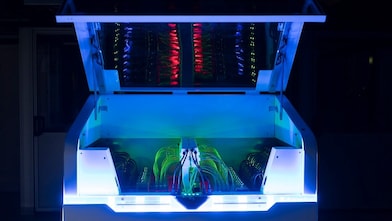
Shell and Asperitas work in partnership to promote immersion cooling and develop cooling fluids. The technology enables the deployment of sustainable, high-density data centres wherever they are needed, regardless of climate.

We are proud to announce that Shell and Asperitas are featured in the latest World Economic Forum Report on Transformational Energy Innovations (page 13 & 14).
This new report from the World Economic Forum showcases selected global energy innovations from the past decade which are judged to be novel, beneficial to society, and contributing to accelerating the global energy transition.
Keep cool! Find out more about our innovation
Shell Immersion Cooling by Edu
Read the transcript
Read the transcript
Title: Shell Immersion Cooling by Edu
Duration: 11:09 minutes
Description:
Shell Immersion Cooling Fluid PPT by Eduardo in OCP Global virtual Summit 2020
Shell Immersion Cooling by Edu
Transcript
[Background music plays]
No background music
[Animated sequence]
No animation
[Text displays]
It is a presentation, the text will be presented in voice
[Conversation/ speech Title]
Product Application Specialist at Shell Global Commercial Technology
{Name of speaker}
Eduardo de Azevedo
[Visuals]
{Visual transition/change, e.g. Split screen, video footage, etc.}
Powerpoint Presentation, no footage
[Text displays]
Shell Immersion Cooling Fluid - OCP Global virtual Summit 2020
May 12-14, 2020
[Eduardo de Azevedo]
[Product Application Specialist at Shell Global Commercial Technology]
[Slide 1]
So we can get started.
Good morning or good day ladies and gentlemen. I hope that everybody is well and safe during this unusual of times of COVID-19. As you can see, I'm recording this presentation from my Home Office and I wish to have the opportunity to meet all of you very soon. Please allow me to introduce myself. My name is Eduardo de Azevedo. I'm a product application specialist at Shell Global Commercial Technology based in Hamburg, Germany. I'm also leading the development of our Shell Immersion Cooling Fluid for computer data centers.
[Slide 2]
This slide is a cautionary note that remind us do not use the information in this presentation as the base for any trading activities. I trust this is clear.
[Slide 3]
Firstly, I would like to thank the OCP community and members for this opportunity to present here today. Looking at those OCP members’ mission and values, it is my pleasure and honor to start working in collaboration towards a better world for our children and future generations. The world is changing to a lower carbon energy system.
Shell is a large company that supplies around 3% of the energy the
world uses. We want to play your part and contribute to the global effort to tackle climate change and meet the goal of the Paris agreement. Shell's purpose is to provide more and cleaner energy as the
world continues to grow. We support the energy transition via development and investments in lower carbon products and technologies. But we cannot do it alone and that's why we partner with the immersed cooling specialist Asperitas on the development of innovative energy solutions, aiming to reduce data centers energy consumption.
With the rise of digitalisation, computing power is ever increasing. Data networks consumed around 260 TWh globally 2018 or about one point, 1.1% of total global electricity demand. It is estimated this demand could rise nearly 10% in 2021. By optimizing the cooling technology, in other words, moving from air to liquid cooling, energy consumption is reduced, used more efficiently and it allows us to use the residual heat to be reused in a sustainable way by surrounding communities.
[Slide 4]
So, as part of our ambition. I'm delighted to introduce you to our new Shell Immersion Cooling Fluid. Our fluid was developed and co-engineered with our strategic partner Asperitas. It is optimised for Asperitas natural convection driven immersion cooling solutions but can also be used in pump or forced circulation systems. Shell Immersion Cooling Fluid is a synthetic, single-phase immersion cooling fluid made from natural gas using Shell GTL gas-to-liquid technology. In this slide you can see a brief description of the Shell gas-to-liquid GTL technology, which basically converts natural gas into high quality liquid products. GTL fluids have a water white colour and offer a uniform chemical structure, a high flashpoint and low volatility and an outstanding light and thermal stability. The products are colorless and contain virtually no sulfur, nitrogen, or aromatics that are found normally in conventional
crude oils.
The GTL manufacturing process consists of three stages:
At the first stage, synthesis gas are mixture of hydrogen and carbon monoxide is manufactured from natural gas. Impurities are removed from the syngas at this stage.
The second one converts the synthesis gas into liquid hydrocarbons using a catalyst. In this stage, a liquid is formed which looks and feels like a wax at room temperature. Just to give you an idea.
The final stage cracking an isomerisation which "tailors" the molecule chains into products with the desired properties.
This yields on liquids with a high level of purity and well defined Iso-paraffinic molecules which influences significantly the fluid physical properties, specifically thermodynamics. On the table above you can see the Shell Immersion Cooling Fluid typical properties for your reference.
[Slide 5]
So, associated with the high purity of the GTL medicinal base oil with specifically selected additives to ensure even higher thermal an oxidation stability during operation. Important to mention that during the fluid development, we have considered all the details and specific aspect for immersion computing application such as materials, conditions and the location where the modules will be installed and deployed.
For us at Shell, the safety of the employees, customer and society is the upmost priority. As the GTL synthetic based oil meets the US and European Pharmacopoeia purity requirements and is food grade certified, the safety of the people handling the fluid is improved. The fluid extremely lower volatility and non-evaporating characteristics contributes not only with a safer environment but also with sustainability and not depleting the ozone layer.
Its lower density means that the fluid is "lighter" per cubic meters contributing in the data centers customers to save money in infrastructure and ground foundation reinforcement for their modules, comparing with other fluid technologies that could reach up to two times "heavier" per cubic meters than the density of our fluids. The liquid has high cooling efficiency, excellent flow behavior as well as thermodynamic properties and will be available across the immersion cooling market. In easy words, due the purity of the GTL there is nearly nothing in the oil which can react with components.
[Slide 6]
Our Global Commercial Technology and Projects & Technology teams work together around the world, exchanging expertise and know how among our team and our technology centers globally. Specifically, in Amsterdam, Hamburg, Houston, Shanghai and Bangalore with the highest customer centricity. We use the expertise acquired along the latest decades in formulating an producing the highest top tier lubricants, dielectric and thermal fluids in majority of the industry sectors. We work in collaboration with our customers to overcome their challenges, taking advantage of our fluid analytical capabilities specially when it comes to compatibility tests and fluid analysis.
For example, we list a few tests which are key to understand the fluid and equipment condition. The first one is the ICP (Inductive Coupled Plasma), which is an important test to determine if there is any metal or organic component in the fluid, either coming from leaching out from the components or any possible external contamination. By identifying these elements, we can help to understand the source and monitor the trends. Another test is the FTIR (Fourier Transform Infrared) in the example above. This graph shows the spectrum of a piece of cable over another spectrum from database where it's possible to identify the constitution of the material and mitigate any compatibility challenges. This is very helpful where we don't know exactly the material components. Oxidation acidity tests are also important to determine the fluid condition over the time. Last, but not least, in this slide, the thermal functional tests such as specific heat, thermal conductivity and relative permittivity are also made to understand the fluid performance.
So, finally they are 3 takeaways. I want you to take along today.
The first one, the new shell immersion cooling fluid is innovative GTL based solution for data centers.
The second one, it will help us on our sustainability journey by reducing the CO2 footprint.
The third one is that leverages reduction of TCO (Total Costs of Operation) of the customer.
With that said, I would like to take this moment to thank you for attention. I will be glad to answer any questions during the Q&A session.
Best regards, stay safe and greetings from Hamburg. Bye bye.
[Slide 7]
Shell Pecten
OCP TV - Rolf & Sundeep
Read the transcript
Read the transcript
Title: OCP TV – Rolf & Sundeep
Duration: 18:22 minutes
Description:
OCP TV's Laura Noland interviewed Eduardo De Azevedo from Shell and Maikel Bouricius from Asperitas who talked about their presence at the upcoming OCP Virtual Summit on May 12th - 15th.
The Virtual Summit is a rich, interactive experience that can be accessed from anywhere in the world, that incorporates all the key components of the OCP Global Summit, including keynote sessions, executive tracks, an Expo Hall with Expo Hall talks, Engineering Workshops, the OCP Experience Center and the OCP Future Technologies Symposium.
OCP TV – Rolf & Sundeep Transcript
[Background music plays]
No music
[Animated sequence]
No Animation
[Text displays]
It is an interview
[Conversation/ speech Title]
{Name of speaker}
Laura Noland - OCP TV's
Rolf Brink - CEO of Asperitas
Sundeep Kamath - Global Marketing Manager, Shell
[Visuals]
3 video screens on desktop showing the 3 speakers
[Laura Noland]
Welcome to OCP TV the newsroom for the Open Compute Project Foundation. I'm Laura Noland at the 2020 OCP virtual summit. Joining me today is Rolf Brink, CEO of Asperitas and Sundeep Kamath, Global Marketing Manager of Shell. Welcome to both of you to OCP TV.
[Rolf Brink]
[Sundeep Kamath]
Thank you, happy to be here indeed
[Laura Noland]
Wonderful, well lots to talk about today, so let's get started. First tell our viewers about Asperitas and Shell. What you do separately and then together as a partner?
[Rolf Brink]
Asperitas is an immersion cooling company based in the Netherlands, currently based in Amsterdam even, and we've been in the market focusing on optimising IT equipment for immersion as well as selling our immersion systems which are quite unique in many ways because we don't require any moving parts to circulate the liquids or our systems are thermally driven and part of our development focus is the sustainability aspect so one of the things that we're committed to is optimising IT platforms, compute platforms in such a way that they can generate high-grade heat and that is something that is in high demand especially across Europe but also in many other areas in the world.
What we basically make possible is the fact is we are enabling the transition from data centers towards energy producers in ways, so with our technology data centres can generate an output of hot water which can be directly inserted into district heating systems or directly be reused by entire cities and that focus on that high-grade heat also allows us to deploy our systems with climate independence in mind. It also means that we're very tolerant to high temperature cooling, which means it doesn't matter for the system whether it's located in the arctic area or in the Sahara Desert that depending on the IT platform exercise which is something that is quite unique.
[Sundeep Kamath]
Shell is a global energy company and our mission is powering progress together by providing more and cleaner energy solutions. The fact is everyone needs energy to prosper and the absence of energy limits progress but the way people currently produce and consume energy create CO2 and global warming. Cross industry collaboration we think is fundamental to helping society reach the goal of net zero emissions and at Shell we are committed to play our part.
Our partnership with Asperitas to us is a demonstration of this commitment. The global data centre industry as we know has been one of the fastest growing energy consuming industries and it accounts for about one percent of global energy demand in 2018 and it's projected to continue growing. The technology that Asperitas has developed helps to reduce the energy footprint of data centres by up to forty five percent by immersing the IT hardware in a fluid that's specifically designed by Shell for the data server immersion cooling technology. We believe this technology has fantastic potential to completely revolutionise this industry and it's very exciting for us and that's why we are we have partnered with Asperitas.
[Rolf Brink]
One of the things that we should highlight here as well is the fact that we are jointly developing liquids for the entire industry to use as a dielectric liquid with a global supply capability of Shell and also with a large focus again on the energy reuse, Shell also being an energy party. A global energy party can help with this type of sustainability developments for data centres.
[Laura Noland]
Wow, I was just listening to each of you explaining the partnership and what you are doing together. It's gonna have a huge impact on the industry. This is gonna be an exciting platform. The OCP virtual summit will be an exciting platform for you to really share this with the community even further so I'm excited to learn more for sure and I'm sure a lot of folks at the summit will be too. So, you are sponsored this year so why was it important to be part of the summit and in a more visible fashion?
[Rolf Brink]
Well it is important as it is a global event for all hyper-scalers and the main OCP event of the year. Asperitas is leading the immersion efforts in OCP and from this capacity we're also involved with the organization of the summit itself, so and there are good reasons for doing that because there's a lot that is happening around immersion technology. This year as well and especially in the upcoming year so it's really important to ensure that the industry gets together and start embracing the liquid merit message and again more importantly even the sustainability, much as that surrounds it because that is very tightly related to the liquid cooling message.
[Sundeep Kamath]
Indeed. At Shell, as I mentioned, the challenge we all face from climate change requires a fundamental shift in thinking and cross industry collaboration we believe. OCP is a leading forum where we hope to engage with the key industry participants to identify and enable the de-carbonisation pathways so that they can follow towards a net zero emissions future.
[Laura Noland]
What's the latest? What's happening at Asperitas and Shell lately that you can share with our community? Any big news, any big announcements coming up?
[Sundeep Kamath]
Shell has recently just announced our revised ambitions. We have significantly raised our ambitions in relation to climate change so our goal, which was just announced last week, is now to be a net zero emissions energy business by 2050 or sooner, which, as you can imagine, is not going to be easy. It is a challenge for an energy company, but the Shell/Asperitas partnership is a real-life demonstration of this.
We have just launched Shell Immersion Cooling Fluid S5X which is a fluid that is specifically developed for immersion computing applications and conditions. It's developed using our patented gas-to-liquids technology, so the base fluid that we use to manufacture this fluid is actually made from gas, it's not derived from crude. How I like to visualize it is that it's like putting Lego blocks together, so we basically take the gas molecules and we fit them together to develop the fluid that we need, so it's absolutely pure. It's absolutely clean and it’s of a medicinal quality. The fluid is actually a product of both our companies’ strategic fluid development partnership and there's lots of research and development that we have done together. This is again in line with Asperitas’ leadership role on the immersion cooling technology, the OCP advanced cooling solution sub-project and in line with Shell’s desire to support innovative energy solutions.
[Rolf Brink]
If you look at the joint development of immersion cooling fluid, I would like to add something from my perspective on that liquid development on Shell’s side with the GTL process, the gas to liquid process. One of the things that Asperitas has in the highest regard is quality. Quality of our systems are the type of requirements that we put in place for our own technology are tremendously high and the value that is added by the Shell liquids also relates to that quality level. The gas-to-liquid process allows basically the manufacturing over liquids on a molecular level, so with the Lego blocks that Sundeep just explained. We end up with such a high consistency, such a predictability and such a high stability of the liquids that it's safer than any other liquid in the market and trust me, we've tested quite a few when we've worked with a lot of them. But nothing has been able to rival with the Shell fluids in this case. The reason why that's very important is the incredible IT value, the equipment value and also the value of the platform that needs to run on it. Especially in our markets, those values are really very high and that's something that we need to protect and this is what this liquid is optimised and enhanced for.
One of the things that Asperitas is sharing as news at the digital summit is the open source chassis that we're publishing on (that we're sharing it with the community) that is also combined with a new and larger immersion cooling solution that we're launching now that will make use of the full potential of our immersed computing concept. The system offers full flexibility to OEMs and also the abilities with the open source chassis and also system integrators and end-users to facilitate high-density compute and OCP ready 21 inch server solutions. At the summit we're sharing our efforts on the open server cassette design for immersion and we're promoting the use of that. So, based on this open source chassis, we're also launching and announcing several new OEM relations and joint development projects with some very well-known vendors which are also part of the OCP domain.
We're focused on the sustainability angles as well and this is the immersion cooling fluid and the hardware that we're building are also building blocks just like Shell’s ability to provide renewable power and heat reuse concepts and this is what's driving us on acting together on the summit's here as well.
[Laura Noland]
Wow, so lots of news to share at the OCP virtual summit. You had me at “Lego blocks” because, not to take away from any of the magnitude of what you're talking about, because it’s very exciting and very innovative and I know that a lot of people want to learn more, but it was a great visual, a great takeaway to really comprehend something so complex, so we can take it away quickly of how it actually works, appreciate that. You're sharing a lot of course at the summit – lots of big news from you guys. What do you hope to take away? Because you're contributing quite a bit. What do you hope to pull back from the summit and take back with you?
[Rolf Brink]
Basically the opportunity to showcase solutions connected with the OCP activities on the standardisation of immersion cooling technologies and IT equipment specifications while supporting the large-scale implementation of immersion cooling technology by cloud hyper-scale, telecom providers and other OCP adopters. X computing is an area we see as a strong development driven by telecom providers and public cloud providers and OCP announced last year that we would see most growth in this area.
We are expecting to see a lot more exciting developments on this and of course sustainability is a global thing so being able to operate anywhere in any climate but also enabling concepts when it's in neutral data centres is an area we hope to see a lot more of. There's a lot of stuff happening within the OCP domain, there's a lot of other companies. Microsoft even announced the carbon negative angles and we're hoping to see a lot more of that happening as well. I think a hyper scalar environment is having a leadership role for the entire data center industry and everybody's looking at how they're doing it, what they're doing and that's something I would love to see and I hope to take away from the OCP Virtual Summit.
[Laura Noland]
Let's talk about how you got started with the open compute project. Why did you decide to become part of this community, as you're taking the relationship with Asperitas and Shell to the community. Why be a part of the community and what benefits you’ve seen from it?
[Rolf Brink]
Asperitas is driving a whole new technology ecosystem, not just a technology by itself. The technology can only exist in an ecosystem and part of the strategy is to grow that ecosystem. We're not only focused on growing a company and growing on market share, no, we're actually focused on growing the market itself. It's a fundamentally different approach than just trying to compete with your competitors, what we're trying to do is something different, to facilitate.
As markets grow, there is a lot that needs to happen and that needs to be developed to allow the market to adopt liquid cooling technologies at a really significant scale. It's required, it's necessary if we want everyone to make this a sustainable industry and since nobody was making any efforts towards this kind of scaling off the market itself and nobody was taking that leadership role to guide the industry to a different level, we've basically decided that we had to take that place. If nobody is doing it, let's just do it ourselves and make sure that we generate some basic standards, some basic frames of reference and do that in the community and do it together with people who are like-minded and who are interested to bring this industry to a larger scale and that is exactly what has happened for the several publications that we have that we have helped with and facilitated and some of them have authored or co-authored. That should help the industry to come from a joint perspective, to start operating on a centerline. That's also a fundamental part of our development approach where we've developed our technology for scale, so when it comes to standardisation and open innovation to make sure that's something that we embrace to make sure that it can reach its full potential.
Last but not least, many of strongest and closest partners are also part of the consortium and it's a great platform to share progress, just like we're doing now with Shell.
[Laura Noland]
So where can our viewers go to learn more?
[Rolf Brink]
We are at the virtual booth in OCP Virtual Summit. They can find us at www.asperitas.com and the Shell link from our page to Shell Immersion Fluid.
website summits where can we find you
we've got a virtual booth, to be honest we're going to be present at the virtual booth so that that's where you can talk to us. Speak with us learn more about us. Sadly, we're not able to showcase our systems live at the in a physical location right now due to the current global situation but on the Asperitas and Shell website you can find all information that you would like about the immersion cooling fluids as well as the exciting Shell gas-to-liquid process.
[Sundeep Kamath]
Shell will be present also together with Asperitas at our virtual booth. We are very much looking forward to present in San Jose in person but I guess you know with the Covid-19 situation virtual is what we can do for now and yeah come and see us there, lots more to come from a spirit isn't show
[Laura Noland]
Thank you so much for joining us today.
OCP TV – Maikel & Eduardo
Read the transcript
Read the transcript
Title: OCP TV – Maikel & Eduardo
Duration: 10:09 minutes
Description:
OCP TV's Laura Noland interviewed Eduardo De Azevedo from Shell and Maikel Bouricius from Asperitas who talked about their presence at the upcoming OCP Virtual Summit on May 12th - 15th.
The Virtual Summit is a rich, interactive experience that can be accessed from anywhere in the world, that incorporates all the key components of the OCP Global Summit, including keynote sessions, executive tracks, an Expo Hall with Expo Hall talks, Engineering Workshops, the OCP Experience Center and the OCP Future Technologies Symposium.
OCP TV – Maikel & Eduardo Transcript
[Background music plays]
No music
[Animated sequence]
No Animation
[Text displays]
It is an interview
[Conversation/ speech Title]
{Name of speaker}
Laura Noland - OCP TV's
Maikel Bouricius - Marketing Manager, Asperitas
Eduardo de Azevedo - Product Application Specialist, Shell
[Visuals]
3 video screens on desktop showing the 3 speakers
[Laura Noland]
Welcome to OCP TV, the newsroom for the Open Compute Project Foundation. I'm Laura Noland at the 2020 OCP Virtual Summit. Joining me today is Maikel Bouricius, Marketing Manager at Asperitas and Eduardo de Azevedo, Product Application Specialist for Shell. Welcome to both of you to OCP TV.
I understand that you are announcing several products – one of them being the Shell Immersion Cooling Fluid. Can you both tell us a little bit more about the relationship and how this product came to be?
[Maikel Bouricius]
So, a little bit of background on the collaboration…we have been working with Shell products since our R&D phase, but more closely since 2018 when we won the New Energy Challenge, which is a competition Shell co-organizes annually. Since then, we work together on a strategic level for partners on the development of tailored immersion cooling fluid for data centres of course. All based on our insights, we have developed and built up throughout each since our R&D delays and first pilots and the current project deployments but maybe Shell can further explain on the background of the development itself.
[Eduardo De Azevedo]
We used expertise acquired along the latest decades in formulating and producing the highest top tier lubricants – dielectric and thermal fluids to the majority of the industry sectors like automotive and power industry. Our global commercial technology and project technology teams work together around the world exchanging expertise, know-how among our team and our technology centers in Amsterdam, in Hamburg, in Houston, in Shanghai and among Bangalore with the highest customers interested. We used the in depth expertise, the global network and our long lasting experience to develop the fluid for the immersion cooling application.
[Laura Noland]
So, what would you say are the unique aspects of this immersion cooling fluid?
[Eduardo De Azevedo]
Our fluid was developed in collaboration with Asperitas, which is our strategic partner. It's also optimized for Asperitas’ natural convection driven immersion cooling solutions but can also be used in pump or faucet circulation systems. Shell immersion cooling fluid is a synthetic single-phase fluid made from natural gas using Shell GTL, which means Shell Gas to Liquid Technology. GTL fluids have a water white colour and offer uniform chemical structure, a high flash point and a low volatility and an outstanding light and thermal stability lower. The products are colourless and contain virtually no sulphur, nitrogen or aromatics that are found in conventional crude oil based products.
[Laura Noland]
So, what were the aspects that Asperitas and the users of the technology, what were they looking for in terms of the fluid?
[Maikel Bouricius]
It’s good to go back a little bit on the development perspective we have partnered on immersion cooling. So when we started out we started to develop on immersion cooling technology which we like to call Immersed Computing for the highest standard of data centres anywhere, but we call enterprise level data centres. When they look for certain technical aspects and behaviour of the fluid – like regarding performance, minimal affiliation, optimal flow but as well one other aspect which is quite important for us in that’s predictability. So when we develop a technology, we want it to run for a long period of time and we want it to be safe and reliable on a predictable level, so when we deploy data centres, our customers know exactly how it will behave in the long term. So through it this was one of them main points we wanted to achieve, but beyond the technical aspects there's of course safety and reliability and ensuring the fluid itself has been designed for this purpose and not just adapted for it. So that's what we are looking for and more generic in terms of partnerships, our vision is to enable high-performance and sustainable data centres anywhere so when we are connecting with a strategic partner like Shell, it should all add value to this mission we have.
[Eduardo De Azevedo]
From our side as well, it was really interesting because Asperitas helped us to understand their customer requirements and the user specifically for the immersed computing application during the development of the fluid, the materials and the conditions and the locations where the modules would be installed or deployed. Associated with the high purity of this GTL medicinal base oil, we specifically selected the additives to ensure even higher thermal and oxidation stability during the operation, and for us at Shell, the safety of the employees, customer and society is the utmost priority. As a GTL synthetic based oil meets the US and the European purity requirements and is also food grade certified, the safety of the people handling the fluid is approved. So the fluid also extremely lower in volatility and normal operation characteristics contributes not only with a safer environment but also for sustainability and not depleting the ozone layer. In easy words, I would say that due to the purity of the GTL and technology, there is nearly nothing in the oil which can react with the components.
[Maikel Bouricius]
One element I would like to point out is the capability of Shell to do this on a global level, so in terms of this fluid partnership, Shell has control over its own supply chain – from sourcing materials and the manufacturing of this fluid, but as well in terms of our customer success – monitoring after deployments to ensure this long-term success.
[Laura Noland]
I'd like to expand upon that just a little bit Maikel. You touched on Shell and global footprint that Shell has. Can you go into a little bit more detail about what role Shell will play in advancing the solution even further?
[Eduardo De Azevedo]
We work in collaboration with our customers to overcome their challenges, and in taking advantage of our fluid analytical capabilities and compatibility tests for example, we will move forward with this. As we have a technology centres globally, we can provide and support through our global network and offer solutions such as our global lube analyst platform, which gives the customer information about the fluid and equipment condition through the oil fluid analysis. We have a long heritage of fluid monitoring through our lube analyst program and therefore a broad understanding on fluid behaviour and diverse applications.
[Laura Noland]
It seems that Asperitas is having a preference, so to speak, for working with partners on the development of these immersion related components. Why is that?
[Maikel Bouricius]
You’re right Laura, this is basically our approach. We strongly believe that we have an expertise when it comes to developing immersion cooling technologies and solutions, but to use the optimal potential of the technology we like to optimize different components inside our solutions, for example, the IT hardware, servers and compute elements. We have close relationships with OEMs to develop optimised solutions for it and beyond what's going inside the technology, for example the data center from a design perspective, so we strongly believe in those partnerships, where every partner has its own expertise to add value for the overall picture. So I think this fits in very strongly with our approach and you will see that all during the Summit that we will highlight several partnerships, as well as being with Shell. I will point out several OEMs that we're very happy to be working together with.
[Laura Noland]
We can find you during the summit for sure during the OCP virtual summit, but where can our viewers go in the meantime to learn more?
[Maikel Bouricius]
They can find us at www.asperitas.com and the Shell link from our page to Shell Immersion Fluid, also reach out to me and Eduardo.
[Laura Noland]
Thank you so much for joining us today.