
Lubricants for Fleet
Solutions that support fleets and their drivers
Maximising long-haul productivity, increasing uptime and getting the most value out of your equipment are crucial when managing a fleet. Those can include extending oil drain intervals, prolonging engine life and improving servicing and maintenance. Shell is a partner with expertise in cutting-edge engine protection and premium lubricants such as heavy-duty diesel engine oils, gear oils and transmission fluids.
Customer Testimonials – See how Shell Lubricants drive Fleet success
Watch how Sarah Weller, Commercial Director of UK Truck & Plant Group, keeps emergency vehicles running smoothly with Shell Rimula and Shell Spirax.
From fire engines to ambulances, Sarah and her team rely on Shell’s premium lubricants to support quality, reliability, and fuel-efficiency performance, helping essential services stay on the road.
Read the transcript
Read the transcript
Title: Lubricant Truck Testimonials - Shell Rimula & Spirax
Duration: 1:38
Description: This is film 2 of the Lubricant Truck Testimonial series. The film shows off Shell Rimula and Shell Spirax fuels.
[Sarah Weller walking across a depot.]
On-screen text: UK Truck & Plant Group uses Shell Rimula & Spirax.
[Sarah Weller in the workshop with vehicles behind her.]
SARAH WELLER: After decades in the industry, I'm still known as ‘the girl who fixes lorries.’ Welcome to our workshop.
[The camera zooms out to show more of the workshop around Sarah.]
SARAH: It's big!
[MUSIC PLAYING]
[Sarah, standing in front of a vehicle which is up on a servicing platform.]
SARAH: We service everything…
[A split-screen showing Sarah walking through the workshop on the left, and a fire engine on the right.]
SARAH: …from ambulances to fire engines, vans and trucks.
[Sarah in the workshop.]
SARAH: Our goal is to help…
[Footage of an ambulance driving on a busy road at night with its blue lights on.]
SARAH: …keep the UK's transport and emergency services…
[A split-screen of fire engines on the road, one during the day and one in the evening with its lights on.]
SARAH: …moving safely, reliably and without delay.
[SIREN RINGING]
[A four image split-screen of emergency vehicles in difference scenarios. The shot returns to Sarah in the workshop.]
SARAH: We do feel a sense of responsibility to make sure we can help get the emergency services up and running.
[A split-screen of two fire engines in the workshop. Two men working on the engine of a fire engine.]
SARAH: Fleet customers have high expectations.
[Sarah walking over to two other mechanics who are working on a fire engine.]
SARAH: When customers see we use a Shell premium product, they know we're serious about quality.
[A bottle of Shell Rimula.]
SARAH: We use Shell Rimula engine oils…
[A bottle of Shell Spirax.]
SARAH: …and Shell Spirax transmission fluids…
[Sarah pouring Shell Rimula into an engine.]
SARAH: …both approved by leading OEMs and designed for heavy-duty use.
[Sarah in the workshop again.]
SARAH: These premium lubricants…
[Sarah and a colleague working on the underside of a vehicle.]
SARAH: …extend service intervals and reduce wear. That means fewer breakdowns, fewer repairs, and more uptime for our customers.
[Sarah in the workshop again.]
SARAH: One of our first clients, a local council, reported fuel cost savings of over £25,000…
[Sarah using a computer, perched on top of a barrel in the workshop.]
SARAH: …within a year of switching to Shell Rimula R6 LME Plus engine oil.
[Sarah and a colleague looking at the screen of a tablet.]
SARAH: Using the Shell CO2 and Energy Tracker app, we initially simulated savings for part of the council's fleet.
[The screen of the tablet with Sarah’s colleague pointing to the screen.]
SARAH: In practice, the actual fuel reductions exceeded our projections.
[Sarah in the workshop again.]
SARAH: If they're happy, we're happy.
[Sarah in the workshop with her colleagues standing in a line behind her.]
[LAUGHING AND CLAPPING]
[A fire engine driving down off a ramp.]
SARAH: It's also rewarding to see vehicles we've looked after from day one…
[Sarah walking beneath a vehicle.]
SARAH: …still going strong 15 years later.
[A mechanic, working on an engine.]
SARAH: Shell is part of that story, too.
[Sarah with a yellow Shell Rimula banner on the wall behind her.]
SARAH: It's a brand trusted by generations, just like our workshop…
[Sarah in the workshop again.]
SARAH: …and it's nice to see that same trust passed down from one customer to the next.
[UPBEAT JINGLE]
[A white background spreads in from the edges of the screen, the space it does not occupy forming the outline of the Shell logo. When the screen is fully white, text appears.]
On-screen text: Fuel savings indicated by the CO2 & Energy Tracker tool are typical values seen in both field and lab test evaluation. They do not represent a guarantee that savings will be achieved. Actual savings may be higher or lower than this calculation.
Fuel Economy Improvement are derived from OM501LA Fuel Economy test using 10W-40 as a reference. Fuel economy delta % is obtained through assessing the difference between the two lubricants used both measured against the same industry standard OM501 LA FE test. For conversion to CO2 savings is used GHG intensity factor 2.63 kg CO2/ litre of diesel pure fossil fuel Tank-to-Wheel. (Source JEC WtW study v4.a, 2014, also used in the EU fuels quality directive default values).
This does not include impact of difference in oil drain intervals or actual CO2 manufacturing footprints of the products the numbers shown on the screen are the results of an automated calculation and a manual data entry which can be subject to inaccuracy. This video contains promotional content.
Read full disclaimer at www.cellcom/ investors/ disclaimer-and-cautionary note
[The text disappears and the Shell logo appears in the centre of the screen along with more text.]
On-screen text: POWERING PROGRESS TOGETHER. SHELL INTERNATIONAL LIMITED 2025
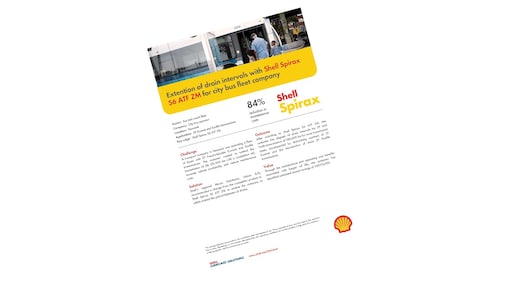
A Danish transport company achieved estimated annual savings of US$113,000 by switching to Shell Spirax S6 ATF ZM, extending oil drain intervals from 30,000 to 180,000 km in ZF and Voith transmissions.
Explore our Lubricants for Trucks and Buses
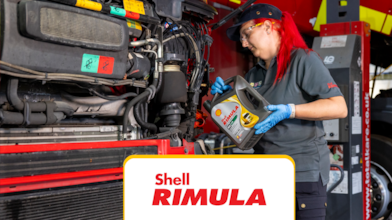
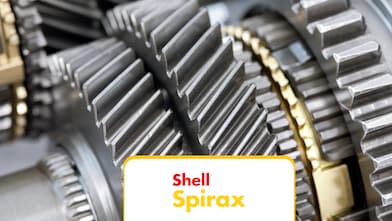
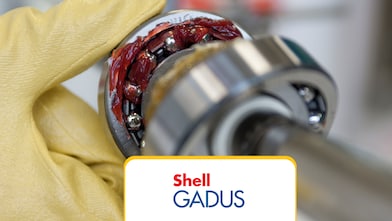
Powering Fleet performance: How selected advanced lubricants can support fuel-efficiency improvements, operational performance and evolving mobility needs.
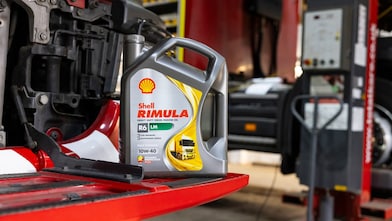
Boost Fleet efficiency with advanced Lubricants
Fuel remains the largest contributor to fleet operating costs in Europe, accounting for over half of total cost of ownership (TCO). One way to help reduce fuel consumption in suitable applications is by using low-viscosity lubricants that meet the relevant OEM specifications. These oils are designed to reduce friction and improve engine efficiency, with Shell Rimula R7 products demonstrating up to 3.9% better fuel economy versus specified reference oils under controlled testing conditions.1 For large fleets, these improvements may translate into operating-cost savings across multiple vehicles, without requiring hardware upgrades or driver retraining.2

Support fuel-related sustainability ambitions with suitable lubrication choices
By choosing lubricants that meet relevant OEM specifications for modern engines, fleet managers can support effective engine operation in vehicles designed to meet applicable emissions standards, while maintaining high performance.
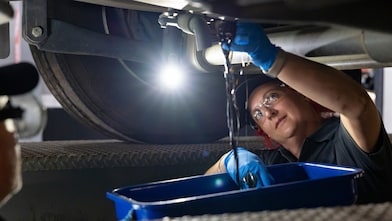
Extend vehicle lifespan and reduce maintenance downtime
Modern engines are smaller, hotter, and more powerful4 - placing greater stress on lubricants. Shell’s advanced formulations are engineered to protect critical components under extreme conditions, helping prevent wear and reduce breakdowns. For fleet owners, this may result in longer service intervals, fewer unplanned repairs, and improved uptime. In high-utilization fleets, every hour saved on maintenance is an hour gained in productivity.
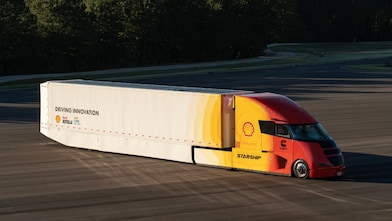
Prepare for the future of Fleet mobility
As Europe continues its shift toward alternative fuels and electrification, lubrication strategies are expected to evolve. Whether your fleet includes diesel, LNG, or electric vehicles, Shell offers lubricants and technical support for a range of powertrains. Choosing suitable lubricants that meet relevant specifications can help fleets maintain performance and efficiency as the mobility landscape changes.
Disclaimer
1Based on controlled field testing which produced statistically significant data. 1% fuel economy benefit proven for Shell Rimula R7 products vs a 5W-30 (3.5 mPa·s) HTHS. Shell Rimula R7 range has demonstrated 3% fuel economy when compared to a 10W-40 and 3.9% when compared to a 15W-40.
2Nearly 70% of fleets with more than 1,000 vehicles used efficiencies in the last two years. By contrast, only 42% of fleets with fewer than 1,000 vehicles report use of these efficiencies in the annual survey. Source: Gladstein, Neandross & Associates. “The State of Sustainable Fleets ” 2023.
3https://data.consilium.europa.eu/doc/document/ST-14284-2023-INIT/en/pdf
4Compared to previous-generation engines
Knowledge hub
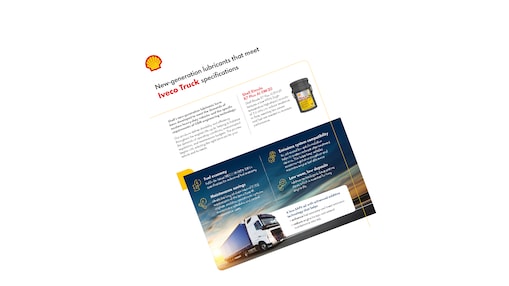
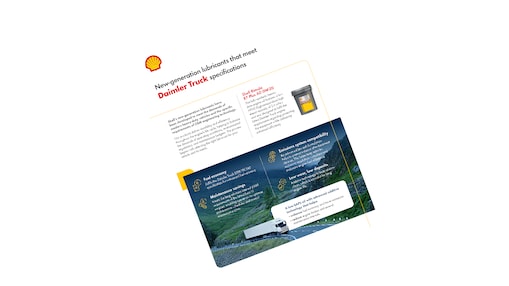
Shell's new-generation lubricants, specifically designed to meet OEM specifications
Services

Shell LubeAdvisor
The Shell LubeAdvisor service is delivered through highly trained Shell technical staff consisting of office-based technical helpdesks and field-based lubrication engineers. In addition, there are a number of helpful and convenient tools for you to use, with the complete Shell LubeAdvisor service offering you a wealth of engineering, technical and application knowledge.
Cautionary note
Cautionary note
The companies in which Shell plc directly and indirectly owns investments are separate legal entities. In this content “Shell”, “Shell Group” and “Group” are sometimes used for convenience to reference Shell plc and its subsidiaries in general. Likewise, the words “we”, “us” and “our” are also used to refer to Shell plc and its subsidiaries in general or to those who work for them. These terms are also used where no useful purpose is served by identifying the particular entity or entities. ‘‘Subsidiaries’’, “Shell subsidiaries” and “Shell companies” as used in this content refer to entities over which Shell plc either directly or indirectly has control. The terms “joint venture”, “joint operations”, “joint arrangements”, and “associates” may also be used to refer to a commercial arrangement in which Shell has a direct or indirect ownership interest with one or more parties. The term “Shell interest” is used for convenience to indicate the direct and/or indirect ownership interest held by Shell in an entity or unincorporated joint arrangement, after exclusion of all third-party interest.
Forward-Looking statements
This content contains forward-looking statements (within the meaning of the U.S. Private Securities Litigation Reform Act of 1995) concerning the financial condition, results of operations and businesses of Shell. All statements other than statements of historical fact are, or may be deemed to be, forward-looking statements. Forward-looking statements are statements of future expectations that are based on management’s current expectations and assumptions and involve known and unknown risks and uncertainties that could cause actual results, performance or events to differ materially from those expressed or implied in these statements. Forward-looking statements include, among other things, statements concerning the potential exposure of Shell to market risks and statements expressing management’s expectations, beliefs, estimates, forecasts, projections and assumptions. These forward-looking statements are identified by their use of terms and phrases such as “aim”; “ambition”; ‘‘anticipate’’; “aspire”, “aspiration”, ‘‘believe’’; “commit”; “commitment”; ‘‘could’’; “desire”; ‘‘estimate’’; ‘‘expect’’; ‘‘goals’’; ‘‘intend’’; ‘‘may’’; “milestones”; ‘‘objectives’’; ‘‘outlook’’; ‘‘plan’’; ‘‘probably’’; ‘‘project’’; ‘‘risks’’; “schedule”; ‘‘seek’’; ‘‘should’’; ‘‘target’’; “vision”; ‘‘will’’; “would” and similar terms and phrases. There are a number of factors that could affect the future operations of Shell and could cause those results to differ materially from those expressed in the forward-looking statements included in this content, including (without limitation): (a) price fluctuations in crude oil and natural gas; (b) changes in demand for Shell’s products; (c) currency fluctuations; (d) drilling and production results; (e) reserves estimates; (f) loss of market share and industry competition; (g) environmental and physical risks, including climate change; (h) risks associated with the identification of suitable potential acquisition properties and targets, and successful negotiation and completion of such transactions; (i) the risk of doing business in developing countries and countries subject to international sanctions; (j) legislative, judicial, fiscal and regulatory developments including tariffs and regulatory measures addressing climate change; (k) economic and financial market conditions in various countries and regions; (l) political risks, including the risks of expropriation and renegotiation of the terms of contracts with governmental entities, delays or advancements in the approval of projects and delays in the reimbursement for shared costs; (m) risks associated with the impact of pandemics, regional conflicts, such as the Russia-Ukraine war and the conflict in the Middle East, and a significant cyber security, data privacy or IT incident; (n) the pace of the energy transition; and (o) changes in trading conditions. No assurance is provided that future dividend payments will match or exceed previous dividend payments. All forward-looking statements contained in this content are expressly qualified in their entirety by the cautionary statements contained or referred to in this section. Readers should not place undue reliance on forward-looking statements. Additional risk factors that may affect future results are contained in Shell plc’s Form 20-F and amendment thereto for the year ended December 31, 2024 (available at www.shell.com/investors/news-and-filings/sec-filings.html and www.sec.gov). These risk factors also expressly qualify all forward-looking statements contained in this content and should be considered by the reader. Each forward-looking statement speaks only as of the date of this content. Neither Shell plc nor any of its subsidiaries undertake any obligation to publicly update or revise any forward-looking statement as a result of new information, future events or other information. In light of these risks, results could differ materially from those stated, implied or inferred from the forward-looking statements contained in this content.
Shell’s net carbon intensity
Also, in this conent we may refer to Shell’s “net carbon intensity” (NCI), which includes Shell’s carbon emissions from the production of our energy products, our suppliers’ carbon emissions in supplying energy for that production and our customers’ carbon emissions associated with their use of the energy products we sell. Shell’s NCI also includes the emissions associated with the production and use of energy products produced by others which Shell purchases for resale. Shell only controls its own emissions. The use of the terms Shell’s “net carbon intensity” or NCI is for convenience only and not intended to suggest these emissions are those of Shell plc or its subsidiaries.
Shell’s net-zero emissions target
Shell’s operating plan and outlook are forecasted for a three-year period and ten-year period, respectively, and are updated every year. They reflect the current economic environment and what we can reasonably expect to see over the next three and ten years. Accordingly, the outlook reflects our Scope 1, Scope 2 and NCI targets over the next ten years. However, Shell’s operating plan and outlook cannot reflect our 2050 net-zero emissions target, as this target is outside our planning period. Such future operating plans and outlooks could include changes to our portfolio, efficiency improvements and the use of carbon capture and storage and carbon credits. In the future, as society moves towards net-zero emissions, we expect Shell’s operating plans and outlooks to reflect this movement. However, if society is not net zero in 2050, as of today, there would be significant risk that Shell may not meet this target.
Forward-Looking non-GAAP measures
This content may contain certain forward-looking non-GAAP measures such as adjusted earnings and divestments. We are unable to provide a reconciliation of these forward-looking non-GAAP measures to the most comparable GAAP financial measures because certain information needed to reconcile those non-GAAP measures to the most comparable GAAP financial measures is dependent on future events some of which are outside the control of Shell, such as oil and gas prices, interest rates and exchange rates. Moreover, estimating such GAAP measures with the required precision necessary to provide a meaningful reconciliation is extremely difficult and could not be accomplished without unreasonable effort. Non-GAAP measures in respect of future periods which cannot be reconciled to the most comparable GAAP financial measure are calculated in a manner which is consistent with the accounting policies applied in Shell plc’s consolidated financial statements.
The contents of websites referred to in this content do not form part of this content.
We may have used certain terms, such as resources, in this content that the United States Securities and Exchange Commission (SEC) strictly prohibits us from including in our filings with the SEC. Investors are urged to consider closely the disclosure in our Form 20-F and any amendment thereto, File No 1-32575, available on the SEC website www.sec.gov.
Read full cautionary note at https://www.shell.com/investors/disclaimer-and-cautionary-note.html