
Installing electric vehicle chargers
Shell UK wants to help drivers with more reliable access to electric vehicle (EV) charging near their homes and on the go.
In 2024, 78.2% of Shell’s global investments included oil & gas, 11.37% included low-carbon energy solutions and 10.43% non-energy products. Shell’s target is to become a net-zero emissions (NZE) energy business by 2050. Disclaimers, including NZE target: shell.com/disclaimer
As the UK moves towards its target of net-zero emissions by 2050, Shell UK aims to play a leading role in securing vital energy for today, while investing in, and helping to build, the energy system of the future.
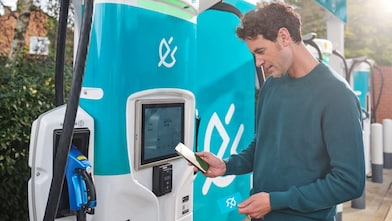
Shell Recharge runs one of the UK’s largest EV public charging networks, providing access to over 35,000 charge points.
On-street
Access over 8,000 Shell Recharge charge points including lamp post and bollard chargers.
On-forecourt
Plug in and charge at a growing number of Shell Recharge chargers at Shell forecourts. There you can also grab a coffee or snack while you wait.
On the go
Find Shell Recharge chargers at partner destinations, like Waitrose and Aldi supermarket car parks.
Download the Shell App and register with Shell GO+ Rewards to unlock savings and have access to exclusive member benefits. Join today and get £2.50 worth of points*
Read the transcript
Read the transcript
Title: Helping power the UK now, and into the future
Duration: 01:23 seconds
Description:
Meet Jade and Helene, part of the Shell UK team. Together we're helping to provide access to thousands of EV chargers, helping power the UK now, and into the future
[Music]
An upbeat orchestral pop song with strings being the lead instruments, part of the familiar Sound of Shell library of music
[Visuals]
A city scene in summer, a white car is pulling into a Shell service station and it parks in an Electric Vehicle parking spot. The camera cuts to inside the white car, a young female with long blonde hair and red jumper turns to camera and introduces herself
[Text displays]
Shell EV charging excludes Northern Ireland
[Text displays and Jade narrates]
I’m Jade I help give Electrical Vehicle Drivers a convenient place to charge
[Animated sequence]
Jade Lilley, Graduate, Shell EV
[Visuals]
The camera cuts to a Shell EV charging unit, the display provides instructions on how to charge the car before cutting back to Jade as she takes off her seat belt, opens the drivers side door exits the white EV car.
[Visuals]
The footage cuts to a slim man as he exits a different car, it’s a blue EV and he’s at a different Shell Recharge charging station within an Aldi supermarket car park. Jade appears at the rear of the blue car, and is taking to camera, as the man in a cream jacket and blue jeans opens the cap and plugs in the starts to charge the car with the Shell Recharge unit. The camera cuts to close ups of the charging unit, the charging device, the car before showing another supermarket, Waitrose.
[Text displays and Jade narrates]
Right now I’m working with Aldi to install Shell Recharge charge points in Aldi car parks. Together with our partner I make sure installing chargers is smooth
Shell UK is also partnered with Waitrose, helping people charge while they shop.
[Visuals]
A white sporty looking car is reverse parking into residential parking space alongside a 1970’s red Mercedes Benz. As the car parks we see a lamp post that has been cordoned off, a workman in a hi vis and PPE equipment is using a screwdriver to open the side of the lamp post next to where the car is parked. A female with long blonde hair, white t shirt and light blue jacket walks towards the camera and introduces herself
[Text displays and Helene narrates]
Or if you park on the street we’ve got you. I’m Helene and I’m in the Shell UK Team helping EV drivers who park here.
We’re making use of existing street furniture like these lampposts, helping EV drivers who can’t charge at home.
[Animated sequence]
Helene Deane, Operations Manager, Shell EV Charging
[Visuals]
The camera cuts to the workman, as he continues his work – he’s converting the lamp post into an on street Shell Recharge unit. The camera does several close up shots of him working, and finally switching the unit on, and sealing the access door shut.
[Visuals]
The footage goes back to the city scene and the Shell service station, Jade is getting out the white car and walks towards the camera talking. She then goes to the Shell Recharge unit, scans her payment card and takes the recharge plug from its holder. She then walks round the car charge point on her white car, and plugs it in to charge.
[Text displays]
Reliability according to Shell internal data. Charger speeds may vary. Visit Shell.co.uk/recharge
[Text displays and Jade narrates]
And of course we’re also meeting customers’ needs on Shell forecourts with reliable EV charging that’s fast and easy to use. Every charge from Shell Recharge comes from 100% certified renewable electricity sources.
I joined Shell UK as a graduate
[Text displays]
Certified by Renewable Energy Guarantees of Origin (REGOs), meaning all of the electricity purchased to supply Shell Recharge sites is match with the equivalent amount of units from 100% renewable sources in the UK
[Visuals]
With the car safely plugged in, Jade turns to the camera and talks. The camera cuts back to Helene on the residential street, she also takes a plug from the newly installed Shell Recharge lamp post and plugs it into her sporty EV car. The camera then cuts to back to the slim man in the Aldi supermarket car park, he’s finished charging his blue car, and replaces the charging plug in the holder.
[Text displays and Jade narrates]
and now have a hands-on impact on the future of EV driving whether it’s on your local street, at supermarkets or at Shell forecourts, Shell EV chargers are rolling out across Great Britain
In fact Shell Recharge operates one of the UK’s largest public EV charging networks.
[Text displays]
In 2024, 78.2% of Shell’s global investments included oil & gas, 11.37% included low-carbon energy solutions and 10.43% non-energy products. Shell’s target is to become a net-zero emissions (NZE) energy business by 2050. Disclaimers, including NZE target: shell.com/disclaimer
[Animated sequence]
A map of the UK and Ireland, with Scotland, Wales and England covered in location markers, showing the extent of Shell’s proposed EV charging network.
[Text displays]
In 2023, 68% of Shell’s global investments included oil and gas, 23% included low-carbon energy solutions and 9% non-energy products. Shell’s target is to become a net-zero emissions (NZE) energy business by 2050. Disclaimers, including NZE target: shell.com/disclaimer
[Visuals]
The footage goes back to the city scene and the Shell service station, Jade walking towards the camera, her white car in the background is charging.
[Text displays and Jade narrates]
Shell UK is helping to power the UK now and into the future.
[Text displays]
In 2024, 78.2% of Shell’s global investments included oil & gas, 11.37% included low-carbon energy solutions and 10.43% non-energy products. Shell’s target is to become a net-zero emissions (NZE) energy business by 2050. Disclaimers, including NZE target: shell.com/disclaimer
[Visuals]
The footage cuts a white screen, Shell shaped ripples spread out from the centre of the screen, and the familiar red and yellow Pecten logo appears in the centre, with the words Powering Progress appearing underneath. In the top right of the screen, the familiar dancing black horse in a yellow shield logo of Scuderia Ferrari HP and Ferrari Innovation Partner.
[Sound]
The familiar five note Shell mnemonic plays brightly on a piano
Powering Progress.
© 2025 Shell International Ltd
Locate your nearest EV charging point
Download the Shell Recharge app to access our large network of public charge points.


Supplying UK gas
Shell UK helps supply more than 20% of the UK’s gas, helping provide the country with more secure energy.

Helping power the UK now, and into the future
From providing access to electric vehicle (EV) chargers, to helping supply UK gas, to building skills for the energy transition. Learn how Shell UK is helping power the UK now, and into the future.
Shell's target is to become a net-zero emissions energy business by 2050.

Shell’s climate target
Tackling climate change is an urgent challenge. That’s why Shell’s target is to become a net-zero emissions energy business by 2050. This means net-zero carbon emissions from our operations. It also means net-zero carbon emissions from the energy products we sell, including those produced by others, which currently account for over 90% of the total emissions we report.
Shell are investing $10-15 billion on low-carbon energy solutions between 2023 and the end of 2025. Shell are also investing in oil and gas production with lower emissions as we provide energy today while helping to build the low-carbon energy system of the future.
Frequently asked questions
Where are Shell Recharge EV chargers located?
Where are Shell Recharge EV chargers located?
You can discover our charging point locations on the Shell Recharge app, or on our website here.
How much does it cost to charge with Shell Recharge?
How much does it cost to charge with Shell Recharge?
In the UK, you only pay the price per kilowatt hour (kWh). You will not pay a transaction fee when charging at Shell Recharge operated charge points that use the Shell Recharge app as a payment method. This includes forecourts and selected Waitrose and Aldi destination sites. You will also not pay a transaction fee if you choose to pay “ad hoc” with a contactless payment method. We always advise you to check the exact tariff on the Shell Recharge app or the public charging tariffs section of the website before starting a charge.
Do Shell Recharge charge points use renewable energy?
Do Shell Recharge charge points use renewable energy?
Shell ensures that every charge from our branded Shell Recharge network comes from 100% certified renewable electricity sources, which is certified by Renewable Energy Guarantees of Origin.
How do I get a public on-street charger installed near where I live?
How do I get a public on-street charger installed near where I live?
All public EV charge points must be procured and installed by your local authority. Teams at Shell-owned ubitricity, which works with local authorities to install Shell Recharge charge points on UK streets, can contact your local authority on your behalf. Fill in this form and they will pass it onto the relevant local authority. Please note that submitting this form does not guarantee a charge point placement.
Why aren’t you installing EV chargers more quickly?
Why aren’t you installing EV chargers more quickly?
There are challenges involved in rolling out EV charging infrastructure. The pace of planning and grid connections across the UK have been patchy in recent years. Planning permission still takes time. Many local authorities are still developing their funding strategies (e.g. speed of adoption of the Local EV Infrastructure (LEVI) Fund which supports local authorities in England to plan and deliver charging infrastructure for residents without off-street parking). Shell UK are addressing permission and connection delays by working with national and local government, as well as distribution network operators to identify gaps and help develop solutions specific to geographical areas.
Legal disclaimer
Legal disclaimer
Cautionary Note
The companies in which Shell plc directly and indirectly owns investments are separate legal entities. In this content “Shell”, “Shell Group” and “Group” are sometimes used for convenience to reference Shell plc and its subsidiaries in general. Likewise, the words “we”, “us” and “our” are also used to refer to Shell plc and its subsidiaries in general or to those who work for them. These terms are also used where no useful purpose is served by identifying the particular entity or entities. ‘‘Subsidiaries’’, “Shell subsidiaries” and “Shell companies” as used in this content refer to entities over which Shell plc either directly or indirectly has control. The terms “joint venture”, “joint operations”, “joint arrangements”, and “associates” may also be used to refer to a commercial arrangement in which Shell has a direct or indirect ownership interest with one or more parties. The term “Shell interest” is used for convenience to indicate the direct and/or indirect ownership interest held by Shell in an entity or unincorporated joint arrangement, after exclusion of all third-party interest.
Forward-Looking statements
This content contains forward-looking statements (within the meaning of the U.S. Private Securities Litigation Reform Act of 1995) concerning the financial condition, results of operations and businesses of Shell. All statements other than statements of historical fact are, or may be deemed to be, forward-looking statements. Forward-looking statements are statements of future expectations that are based on management’s current expectations and assumptions, including (without limitation) those concerning Shell’s strategy and operating plans, macroeconomic conditions, future energy demand, supply and product mix, commodity prices, demand for Shell’s products, production results and reserve estimates, development, execution and management of projects, energy transition and climate change, management of safety and environmental risks, costs, cash capital expenditures, technology advancements, legislative, judicial, fiscal and regulatory developments, regional conflicts and trading conditions, and involve known and unknown risks and uncertainties that could cause actual results, performance or events to differ materially from those expressed or implied in these statements. Forward-looking statements include, among other things, statements concerning the potential exposure of Shell to market risks and statements expressing management’s expectations, beliefs, estimates, forecasts, projections and assumptions. These forward-looking statements are identified by their use of terms and phrases such as “aim”; “ambition”; ‘‘anticipate’’; “aspire”, “aspiration”, ‘‘believe’’; “commit”; “commitment”; ‘‘could’’; “desire”; ‘‘estimate’’; ‘‘expect’’; ‘‘goals’’; ‘‘intend’’; ‘‘may’’; “milestones”; ‘‘objectives’’; ‘‘outlook’’; ‘‘plan’’; ‘‘probably’’; ‘‘project’’; ‘‘risks’’; “schedule”; ‘‘seek’’; ‘‘should’’; ‘‘target’’; “vision”; ‘‘will’’; “would” and similar terms and phrases. There are a number of factors that could affect the future operations of Shell and could cause those results to differ materially from those expressed in the forward-looking statements included in this content, including (without limitation): (a) price fluctuations in crude oil and natural gas; (b) changes in demand for Shell’s products; (c) currency fluctuations; (d) drilling and production results; (e) reserves estimates; (f) loss of market share and industry competition; (g) environmental and physical risks, including climate change; (h) risks associated with the identification of suitable potential acquisition properties and targets, and successful negotiation and completion of such transactions; (i) the risk of doing business in developing countries and countries subject to international sanctions; (j) legislative, judicial, fiscal and regulatory developments including tariffs and regulatory measures addressing climate change; (k) economic and financial market conditions in various countries and regions; (l) political risks, including the risks of expropriation and renegotiation of the terms of contracts with governmental entities, delays or advancements in the approval of projects and delays in the reimbursement for shared costs; (m) risks associated with the impact of pandemics, regional conflicts, such as the Russia-Ukraine war and the conflict in the Middle East, and a significant cyber security, data privacy or IT incident; (n) the pace of the energy transition; and (o) changes in trading conditions. No assurance is provided that future dividend payments will match or exceed previous dividend payments. All forward-looking statements contained in this content are expressly qualified in their entirety by the cautionary statements contained or referred to in this section. Readers should not place undue reliance on forward-looking statements. Additional risk factors that may affect future results are contained in Shell plc’s Form 20-F for the year ended December 31, 2025 (available at www.shell.com/investors/news-and-filings/sec-filings.html and www.sec.gov). These risk factors also expressly qualify all forward-looking statements contained in this content and should be considered by the reader. Each forward-looking statement speaks only as of the date of this content. Neither Shell plc nor any of its subsidiaries undertake any obligation to publicly update or revise any forward-looking statement as a result of new information, future events or other information. In light of these risks, results could differ materially from those stated, implied or inferred from the forward-looking statements contained in this content.
Shell’s net carbon intensity and net-zero emissions target
In this content we may refer to Shell’s “net carbon intensity” (NCI), which includes Shell’s carbon emissions from the production of our energy products, our suppliers’ carbon emissions in supplying energy for that production and our customers’ carbon emissions associated with their use of the energy products we sell. Shell’s NCI also includes the emissions associated with the production and use of energy products produced by others which Shell purchases for resale. Shell only controls its own emissions. The use of the terms Shell’s “net carbon intensity” or NCI is for convenience only and not intended to suggest these emissions are those of Shell plc or its subsidiaries.
Shell’s operating plan and outlook are forecasted for a three-year period and ten-year period, respectively, and are updated every year. They reflect the current economic environment and what we can reasonably expect to see over the next three and ten years. Accordingly, the outlook reflects our combined Scope 1 and 2 target, NCI target and our oil products ambition over the next ten years. However, Shell’s operating plan and outlook cannot reflect our 2050 net-zero emissions target, as this target is outside our planning period. Such future operating plans and outlooks could include changes to our portfolio, efficiency improvements and the use of carbon capture and storage and carbon credits. In the future, as society moves towards net-zero emissions, we expect Shell’s operating plans and outlooks to reflect this movement. However, if society is not net zero in 2050, as of today, there would be significant risk that Shell may not meet this target.
The information provided above regarding Shell’s NCI and net zero emissions target are not intended, nor should they be construed as introducing, suggesting or making any claim, target or representation thereof other than what is included in the content.
Forward-Looking non-GAAP measures
This content may contain certain forward-looking non-GAAP measures such as adjusted earnings and divestments. We are unable to provide a reconciliation of these forward-looking non-GAAP measures to the most comparable GAAP financial measures because certain information needed to reconcile those non-GAAP measures to the most comparable GAAP financial measures is dependent on future events some of which are outside the control of Shell, such as oil and gas prices, interest rates and exchange rates. Moreover, estimating such GAAP measures with the required precision necessary to provide a meaningful reconciliation is extremely difficult and could not be accomplished without unreasonable effort. Non-GAAP measures in respect of future periods which cannot be reconciled to the most comparable GAAP financial measure are calculated in a manner which is consistent with the accounting policies applied in Shell plc’s consolidated financial statements. These forward-looking non-GAAP measures are provided to assist readers in understanding management’s use and expectations of such measures and may not be appropriate for other purposes.
The contents of websites referred to in this content do not form part of this content.
We may have used certain terms, such as resources, in this content that the United States Securities and Exchange Commission (SEC) strictly prohibits us from including in our filings with the SEC. Investors are urged to consider closely the disclosure in our Form 20-F, File No 1-32575, available on the SEC website www.sec.gov.
*Terms and Conditions apply, visit www.shell.co.uk/shellgoplustc. Participating Shell service stations only. New members will receive £2.50 worth of points when joining and opting into marketing communications.
You may also be interested in
Begin your EV journey with Shell Recharge

Powering Progress in the UK