
Supporting UK skills and jobs
Shell UK aims to help 15,000 people into jobs with a focus on the energy transition by 2035. SkillsTransition invests in programmes that help to upskill, reskill and empower a new generation of energy professionals.
In 2025, 80.85% of Shell’s global investments included oil & gas, 9.58% included low-carbon energy solutions and 9.58% non-energy products. Disclaimers: shell.com/disclaimer.
The challenge
The UK’s journey to net zero is likely to create significant economic and career opportunities for the country. But without the right investment, skills, and access to jobs, there is a risk of leaving people behind.
It is estimated that 1 in 5 jobs will experience a shift in demand for skills through the transition to net zero, with around 3 million workers needing some form of reskilling1.
Building skills for the future of energy
To help close this skills gap, Shell UK aims to support 15,000 people into jobs with a focus on the energy transition by 2035. We are doing this by working with partners across the UK to fund and deliver initiatives led by further education colleges, charities, skills bodies and other organisations. These programmes help people develop core employability and energy specific skills needed to progress into meaningful work.
Shell UK's SkillsTransition programme aims to help 15,000 people into jobs with a focus on the energy transition by 2035.
More than 10,000 people have engaged with SkillsTransition programmes so far, building a strong pipeline into jobs.
1 DESNZ, Clean Power 2030 Action Plan: Assessment of the clean energy skills challenge (2025)
Energy Transition Skills Hubs
Energy Transition Skills Hubs, supported by Shell UK, provide teaching space and equipment demonstrating the latest energy technologies. The hubs across the UK provide students with the opportunity to learn and refine critical industry skills. These include welding and fabrication workshops, virtual control room facilities and lessons in nano grid design technology.
The Pembrokeshire and Fife Energy Transition Skills Hubs opened to students in Autumn 2024, while the Aberdeen Energy Transition Skills Hub opened in September 2025.
Shell UK has opened 3 Energy Transition Skills Hubs to support around 5,000 learners.
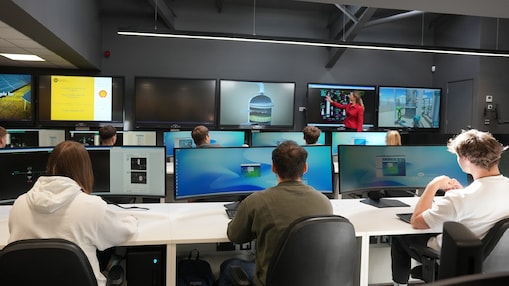
Pembrokeshire Energy Transition Skills Hub
The hub at Pembrokeshire College in Haverfordwest, offers a new virtual control room centre on the existing campus. This innovative specialist centre provides immersive, hands-on training in control systems crucial for offshore floating wind, hydrogen production, solar photovoltaics and other emerging energy technologies. City and Guilds have developed an assured programme which rewards learners with a digital badge on completion. The training centre is available for school leavers, apprentices, existing energy professionals looking to upskill, and local businesses in need of a highly trained workforce. The facility also offers outreach programmes for schools and the wider community, raising awareness of energy transition and inspiring the next generation of engineers and energy professionals.
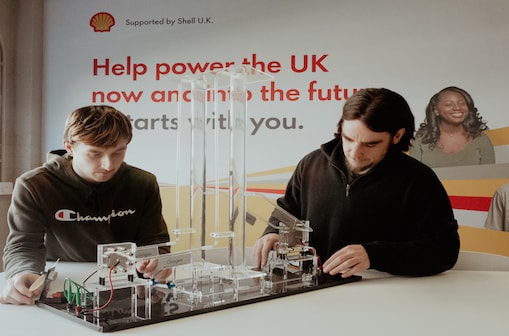
Fife Energy Transition Skills Hub
The Energy Transition Hub at Fife College provides students with an immersive learning environment.
Through hands-on delivery, the Fife Hub provides opportunities for students to gain practical skills in renewable technologies, including SmartGrids, wind energy, EV and solar PV systems.
Students learn about installation and maintenance of renewable systems, as well as digital and data skills for energy.
Later this year, a Nanogrid will be installed, complete with small scale solar panels, wind turbines, sensors and associated software. The planned Nanogrid forms part of SkillStreet, a brand-new facility at Dunfermline City Campus. Skills Street brings together industry led projects including those in Net Zero, energy efficiency, retrofit and wider related skills such as geospatial and data science.
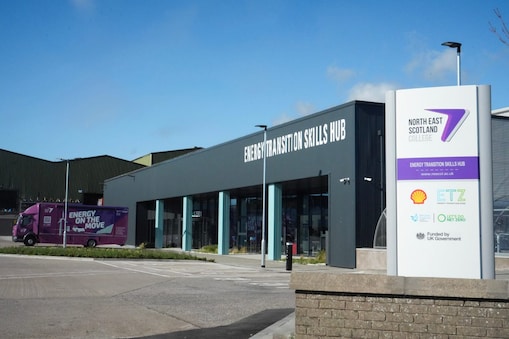
Aberdeen Energy Transition Skills Hub
The Energy Transition Skills Hub was founded by ETZ Ltd, Shell UK and North East Scotland College, with support from the Scottish Government’s Just Transition Fund and UK Government funding. Adura is the lead industry partner. The hub significantly increases the capacity of the existing training facilities for fabrication skills on the existing campus at North East Scotland College and provides a flexible space able to adapt to the skills requirements of the future.
The Hub is built on the site of a disused industrial site next to the college as an extension to the existing campus. The new building has quadrupled the welding capacity of the existing training facilities at the college.
The hub aims to contribute to a just and inclusive energy transition by making a positive social impact on communities. It does this by creating flexible training pathways, removing barriers to access to allow for upskilling and reskilling courses. There is also an outreach programme to get schools involved and inspire the next generation. A mobile classroom staffed with an outreach worker and equipped with interactive technology visits local schools aiming to inspire the next generation about the energy transition.
Some of the employability programmes we are supporting
Discover some of the organisations we are supporting to develop core employability and energy specific skills programmes.

Energise
Shell UK has partnered with Catch22, a charity and social business to found the award-winning “Energise” programme. This is a four-week employability skills programme, with a focus on the energy transition and supporting people into jobs. The programme recruits people from socio-economically disadvantaged backgrounds and equips them with confidence, awareness and employability support to access careers in the energy transition. In two years, Energise has supported nearly 4,000 learners across London, Essex, Norfolk, Suffolk, Manchester and Liverpool - many reporting significant improvements in their confidence and mental health. Over 1,000 people have been helped into jobs so far, 65% of them remaining in employment beyond 6 months.

Energy and Net-Zero Springboard
upReach is a social mobility charity supporting undergraduates from lower socio-economic backgrounds to access and sustain highly-skilled graduate jobs. Shell UK has worked with upReach to launch the first “Energy and Net Zero programme” which supports 340 undergraduates looking for jobs in energy-related sectors.

PowerUp
Shaw Trust is a leading employment charity helping people gain and sustain jobs, providing training for career progression, and championing community health and wellbeing. They offer tailored programmes to support people in upskilling, retraining and accessing new opportunities to drive positive employment outcomes. Shell UK is working with Shaw Trust on the “PowerUp” programme: short,online employability courses to support diverse groups with soft skills around getting into work, while giving them an insight to jobs in the energy sector. The PowerUp programme has already engaged over 750 people on skills programmes across the UK, particularly in the West Midlands.

The Net Zero Careers Accelerator
GoodPeople are a social enterprise connecting local communities to meaningful employment by partnering with public, private, and not-for-profit sectors to deliver place-based social value programmes. Their flagship Net Zero Careers Accelerator (NZCA) service, with Shell UK as Founding Partner, supports local residents to gain the skills and opportunities to secure roles in the rapidly growing energy efficiency, renewable energy, sustainable transport and natural resource management sectors. Shell UK is working with NZCA to collaborate with housing associations, local authorities and businesses to unlock jobs, and find suitable candidates through partnerships with educational institutions and community partners. Since 2024, the NZCA has helped more than 350 people find jobs in energy and net zero. The aim is to increase this to 800 people by 2028.

Domestic EV retraining
City & Guilds is working with Shell UK to increase the number of electricians in the country who have been trained to safely design, install and maintain domestic, small commercial EVC installations. This is through the City & Guilds Ofqual accredited qualifications, designed in partnership with industry and delivered through further education colleges and training providers. This programme has already trained 250 electricians since 2025 and due to its success has been extended for an additional 15-month period, during which a further 250 electricians will receive industry-designed training in domestic EVC installation.

Girls in Energy
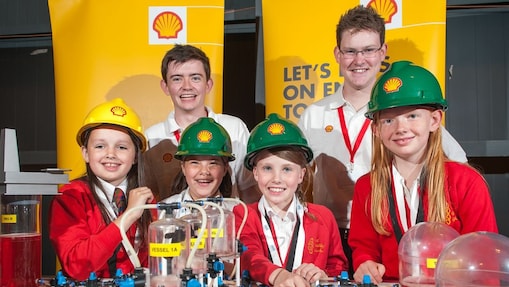
Shell UK founded the Girls in Energy programme and supported its growth for over 15 years, inspiring females to explore careers in STEM and the energy sector.
Delivered with North East Scotland College and Fife College, the year-long course combines learning, industry visits and hands-on workshops, leading to a National 5 Skills for Work Energy qualification.
Today, the programme continues in the North East of Scotland under Adura’s leadership, while Shell UK continues to support delivery in Fife.
Projects we have supported

Powering Refugee Employment - Energy Skills Transition Programme
Breaking Barriers is a specialist refugee employment charity that support refugees into meaningful employment with advice and guidance, education, and training; helping people find financial independence, purpose, and identity through work. Shell UK has worked with Breaking Barriers to launch the Powering Refugee Employment programme, to support around 300 refugees into employment, education, or training across the UK.

Data For Energy Skills Accelerator
Shell UK was the founding supporter of an intensive eight-week online learning programme that teaches sought-after data skills for free. Shell UK funded an 18-month project with FastFutures to deliver a job support programme, teaching data and workplace skills, with a focus on the energy transition. The programme provided learners with the opportunity to achieve a Power BI certificate and was targeted towards individuals from diverse backgrounds.

Sustainability Project Officer
Generation UK is a charity with a mission to support people from disadvantaged backgrounds into sustained employment. With Shell UK's support Generation UK delivered home energy efficiency qualifications through short intensive training programmes. Participants across the UK received wrap-around support and mentoring. Qualified retrofit advisors provide independent advice to homeowners regarding energy efficiency measures. This is a crucial sector in the energy transition as the UK moves towards home decarbonisation.
Naomi Hulston, Chief Executive Officer, Catch22“Through our partnership with Shell UK, we’re able to shape a curriculum that not only builds the confidence of participants, but also equips them with the core skills needed to secure jobs in the sector. The insight that Shell volunteers bring both to the programme development and through insight sessions to participants is invaluable.”
Supporting startups and entrepreneurs

Shell StartUp Engine UK
Shell StartUp Engine UK was launched in 2020 as an acceleration programme designed to boost energy startups in smart sectors like hydrogen, carbon capture, and EV charging, offering mentorship, skills, and Shell's global expertise.

Shell LiveWIRE Scotland
Shell LiveWIRE is Shell’s global enterprise development programme, supporting entrepreneurs with the skills, networks and confidence to start and grow businesses.
In the UK, Shell UK has worked with delivery partner Elevator UK to support small and medium sized businesses with growth potential, focusing on coaching, innovation and access to finance. In recent years, this has supported four cohorts of businesses and contributed to the creation of over 100 jobs.
Though the programme has commenced, Participants continue to benefit from access to the global Shell LiveWIRE alumni network, including mentoring, supply chain opportunities and the annual Top Ten Innovators competition.
More in people and communities

Legal disclaimer
Legal disclaimer
The companies in which Shell plc directly and indirectly owns investments are separate legal entities. In this content “Shell”, “Shell Group” and “Group” are sometimes used for convenience to reference Shell plc and its subsidiaries in general. Likewise, the words “we”, “us” and “our” are also used to refer to Shell plc and its subsidiaries in general or to those who work for them. These terms are also used where no useful purpose is served by identifying the particular entity or entities. ‘‘Subsidiaries’’, “Shell subsidiaries” and “Shell companies” as used in this content refer to entities over which Shell plc either directly or indirectly has control. The terms “joint venture”, “joint operations”, “joint arrangements”, and “associates” may also be used to refer to a commercial arrangement in which Shell has a direct or indirect ownership interest with one or more parties. The term “Shell interest” is used for convenience to indicate the direct and/or indirect ownership interest held by Shell in an entity or unincorporated joint arrangement, after exclusion of all third-party interest.
Forward-Looking statements
This content contains forward-looking statements (within the meaning of the U.S. Private Securities Litigation Reform Act of 1995) concerning the financial condition, results of operations and businesses of Shell. All statements other than statements of historical fact are, or may be deemed to be, forward-looking statements. Forward-looking statements are statements of future expectations that are based on management’s current expectations and assumptions and involve known and unknown risks and uncertainties that could cause actual results, performance or events to differ materially from those expressed or implied in these statements. Forward-looking statements include, among other things, statements concerning the potential exposure of Shell to market risks and statements expressing management’s expectations, beliefs, estimates, forecasts, projections and assumptions. These forward-looking statements are identified by their use of terms and phrases such as “aim”; “ambition”; ‘‘anticipate’’; “aspire”, “aspiration”, ‘‘believe’’; “commit”; “commitment”; ‘‘could’’; “desire”; ‘‘estimate’’; ‘‘expect’’; ‘‘goals’’; ‘‘intend’’; ‘‘may’’; “milestones”; ‘‘objectives’’; ‘‘outlook’’; ‘‘plan’’; ‘‘probably’’; ‘‘project’’; ‘‘risks’’; “schedule”; ‘‘seek’’; ‘‘should’’; ‘‘target’’; “vision”; ‘‘will’’; “would” and similar terms and phrases. There are a number of factors that could affect the future operations of Shell and could cause those results to differ materially from those expressed in the forward-looking statements included in this content, including (without limitation): (a) price fluctuations in crude oil and natural gas; (b) changes in demand for Shell’s products; (c) currency fluctuations; (d) drilling and production results; (e) reserves estimates; (f) loss of market share and industry competition; (g) environmental and physical risks, including climate change; (h) risks associated with the identification of suitable potential acquisition properties and targets, and successful negotiation and completion of such transactions; (i) the risk of doing business in developing countries and countries subject to international sanctions; (j) legislative, judicial, fiscal and regulatory developments including tariffs and regulatory measures addressing climate change; (k) economic and financial market conditions in various countries and regions; (l) political risks, including the risks of expropriation and renegotiation of the terms of contracts with governmental entities, delays or advancements in the approval of projects and delays in the reimbursement for shared costs; (m) risks associated with the impact of pandemics, regional conflicts, such as the Russia-Ukraine war and the conflict in the Middle East, and a significant cyber security, data privacy or IT incident; (n) the pace of the energy transition; and (o) changes in trading conditions. No assurance is provided that future dividend payments will match or exceed previous dividend payments. All forward-looking statements contained in this content are expressly qualified in their entirety by the cautionary statements contained or referred to in this section. Readers should not place undue reliance on forward-looking statements. Additional risk factors that may affect future results are contained in Shell plc’s Form 20-F and amendment thereto for the year ended December 31, 2024 (available at www.shell.com/investors/news-and-filings/sec-filings.html and www.sec.gov). These risk factors also expressly qualify all forward-looking statements contained in this content and should be considered by the reader. Each forward-looking statement speaks only as of the date of this content 21.07.2025. Neither Shell plc nor any of its subsidiaries undertake any obligation to publicly update or revise any forward-looking statement as a result of new information, future events or other information. In light of these risks, results could differ materially from those stated, implied or inferred from the forward-looking statements contained in this content.
Shell’s net carbon intensity
Also, in this content we may refer to Shell’s “net carbon intensity” (NCI), which includes Shell’s carbon emissions from the production of our energy products, our suppliers’ carbon emissions in supplying energy for that production and our customers’ carbon emissions associated with their use of the energy products we sell. Shell’s NCI also includes the emissions associated with the production and use of energy products produced by others which Shell purchases for resale. Shell only controls its own emissions. The use of the terms Shell’s “net carbon intensity” or NCI is for convenience only and not intended to suggest these emissions are those of Shell plc or its subsidiaries.
Shell’s net-zero emissions target
On this page, we may refer to Shell’s “net carbon intensity” (NCI), which includes Shell’s carbon emissions from the production of our energy products, our suppliers’ carbon emissions in supplying energy for that production and our customers’ carbon emissions associated with their use of the energy products we sell. Shell’s NCI also includes the emissions associated with the production and use of energy products produced by others which Shell purchases for resale. Shell only controls its own emissions. The use of the terms Shell’s “net carbon intensity” or NCI is for convenience only and not intended to suggest these emissions are those of Shell plc or its subsidiaries.
Shell’s operating plan and outlook are forecasted for a three-year period and ten-year period, respectively, and are updated every year. They reflect the current economic environment and what we can reasonably expect to see over the next three and ten years. Accordingly, the outlook reflects our combined Scope 1 and 2 target, NCI target and our oil products ambition over the next ten years. However, Shell’s operating plan and outlook cannot reflect our 2050 net-zero emissions target, as this target is outside our planning period. Such future operating plans and outlooks could include changes to our portfolio, efficiency improvements and the use of carbon capture and storage and carbon credits. In the future, as society moves towards net-zero emissions, we expect Shell’s operating plans and outlooks to reflect this movement. However, if society is not net zero in 2050, as of today, there would be significant risk that Shell may not meet this target.
The information provided above regarding Shell’s NCI and net zero emissions target are not intended, nor should they be construed as introducing, suggesting or making any claim, target or representation thereof other than what is included in the page.
Forward-Looking non-GAAP measures
This content may contain certain forward-looking non-GAAP measures such as adjusted earnings and divestments. We are unable to provide a reconciliation of these forward-looking non-GAAP measures to the most comparable GAAP financial measures because certain information needed to reconcile those non-GAAP measures to the most comparable GAAP financial measures is dependent on future events some of which are outside the control of Shell, such as oil and gas prices, interest rates and exchange rates. Moreover, estimating such GAAP measures with the required precision necessary to provide a meaningful reconciliation is extremely difficult and could not be accomplished without unreasonable effort. Non-GAAP measures in respect of future periods which cannot be reconciled to the most comparable GAAP financial measure are calculated in a manner which is consistent with the accounting policies applied in Shell plc’s consolidated financial statements.
The contents of websites referred to in this content do not form part of this content.
We may have used certain terms, such as resources, in this content that the United States Securities and Exchange Commission (SEC) strictly prohibits us from including in our filings with the SEC. Investors are urged to consider closely the disclosure in our Form 20-F, File No 1-32575, available on the SEC website www.sec.gov